
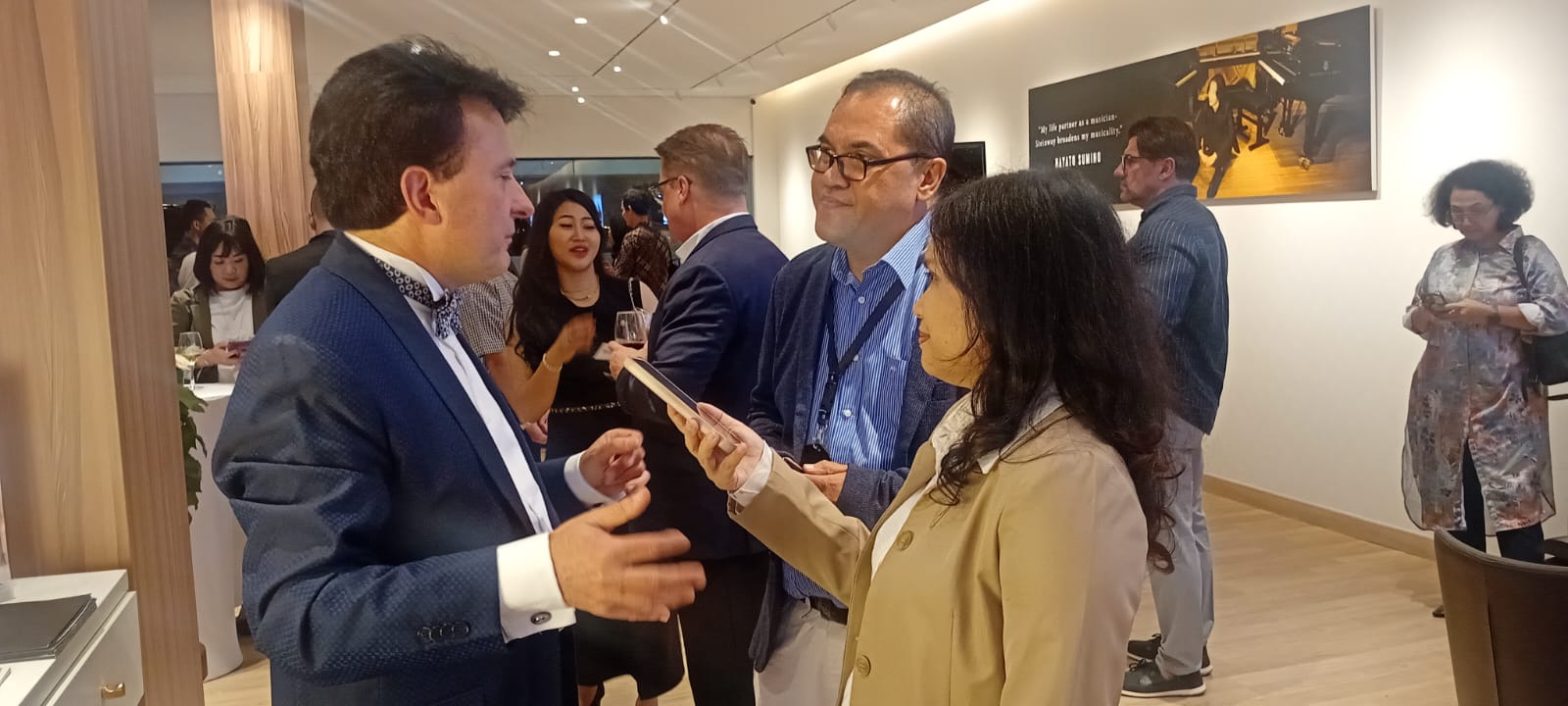
(Business Lounge – Art) On the evening of November 10, 2026, I had the pleasure of attending a special piano recital entitled Fryderyk Chopin: The Sound of Freedom, held at Steinway Gallery Indonesia in Jakarta. The concert, performed by distinguished Polish pianist Rafał Łuszczewski, also known internationally as Raphael Alexandre Lustchevsky, was presented as part of Poland Festival Indonesia, with the involvement of the Embassy of the Republic of Poland in Jakarta. It was an evening that brought together music, history and national identity, offering an opportunity to discover Poland through the extraordinary compositions of one of its most celebrated cultural figures.
The timing of the concert made the occasion particularly meaningful. It took place on the eve of November 11, Poland’s Independence Day, commemorating the restoration of Polish sovereignty in 1918 after 123 years of partitions and foreign rule. For the Polish people, independence is not simply a historical milestone but an enduring expression of national identity, resilience and cultural pride. In this context, Chopin’s music offered a particularly appropriate way to celebrate the occasion. His compositions have long been associated with the Polish spirit, carrying the emotional weight of a homeland that remained deeply present in his life even when he spent much of his career abroad.
In his opening remarks, the Polish Ambassador welcomed guests and emphasized the importance of bringing Poland closer to Indonesian friends through different forms of engagement, including business, culture, food and music. Diplomacy, he suggested, is not limited to formal meetings and political discussions. It is also about creating opportunities for people from different countries to meet, understand one another and share experiences. Music, with its ability to cross geographical and linguistic boundaries, is one of the most effective ways to build such connections. The recital was therefore more than a classical music performance; it was also an expression of cultural diplomacy between Poland and Indonesia.
A Polish Pianist Bringing Chopin to the World
The evening’s performer, Rafał Łuszczewski, is an internationally acclaimed Polish pianist and educator whose international career began in Japan at the age of fifteen. Since 2002, he has performed with leading orchestras and appeared at prestigious venues across Europe, Asia, Latin America and South Africa. His achievements include recognition at major international piano competitions, among them the Clara Schumann Competition in Germany, the Maria Canals Competition in Spain and the UNESCO International Dinu Lipatti Piano Competition in Romania.
A graduate of the Karol Szymanowski Academy of Music in Poland, he also pursued doctoral studies at the Franz Liszt University of Music in Germany. His artistic career has been closely associated with the interpretation of Chopin, and he has released several recordings, including an album featuring Chopin’s complete Ballades. His experience and deep familiarity with the composer’s works were evident in the way he introduced the pieces, providing historical background and explaining the musical character of selected compositions before performing them.
Rather than presenting the programme as a continuous sequence of piano works without explanation, Łuszczewski created a more intimate connection with the audience. His introductions revealed how Chopin approached different musical forms and how some of the names by which his compositions are now popularly known were actually given by later generations. The famous Raindrop Prelude, for example, was not a title originally assigned by Chopin himself. Such explanations added another dimension to the performance, allowing listeners to appreciate not only the beauty of the music but also the stories and interpretations that have developed around it.
The Emotional Language of Chopin
The programme offered a broad journey through Chopin’s musical world, beginning with two Impromptus, followed by the famous Prelude in D-flat Major, Op. 28 No. 15, commonly known as the Raindrop Prelude. The selection also included the Ballade in A-flat Major, Op. 47, Scherzo No. 3 in C-sharp Minor, Op. 39, Waltz in A-flat Major, Op. 34, Nocturne in F Major, Op. 15 and, finally, the celebrated Polonaise in A-flat Major, Op. 53.
Each composition represented a different aspect of Chopin’s musical personality. His Impromptus demonstrated the freedom and spontaneity of his writing, while the Raindrop Prelude offered a more contemplative atmosphere. Łuszczewski explained that Chopin never officially assigned the familiar nicknames to many of his compositions. The descriptions were introduced later, often because listeners and performers felt that certain names captured the character of the music. The Raindrop Prelude is among the best-known examples, with its distinctive recurring notes creating an impression that has become familiar to generations of classical music audiences.
The Ballade in A-flat Major provided another important moment in the evening. Łuszczewski explained that Chopin helped establish the ballade as a significant form of instrumental piano composition. The inspiration was connected to the Polish poet Adam Mickiewicz, whom Chopin encountered during his years in Paris. The pianist also recounted the circumstances surrounding Chopin’s departure from Poland. Following the November Uprising of 1830 against Russian rule, Chopin had been deeply affected by events in his homeland. Although he had wanted to participate in the uprising, his family and friends persuaded him to leave. His initial destination was Vienna, before he eventually settled in Paris, where he became part of a wider community of Polish intellectuals and artists living in exile.
This historical background helps explain why Chopin’s compositions are often interpreted as carrying a sense of longing, nostalgia and national consciousness. Although he lived much of his adult life outside Poland, the country remained central to his artistic identity. His music became a cultural expression of a nation whose political independence had been taken away, but whose language, traditions and artistic heritage continued to survive.
From the Elegance of the Waltz to the Power of the Nocturne
As the concert progressed, the audience was introduced to the different musical traditions that influenced Chopin’s compositions. Before performing the Waltz in A-flat Major, Łuszczewski explained the relationship between the waltz and the social traditions of nineteenth-century Europe. The waltz was closely associated with Austrian and German-speaking societies, where it became an important dance performed in courts, palaces and grand houses.
The Nocturne that followed offered a different atmosphere. Nocturnes are generally lyrical compositions associated with the quiet and reflective mood of the night. However, Łuszczewski pointed out that the particular Nocturne in F Major, Op. 15, also contains a remarkably vigorous and technically demanding middle section. This contrast between lyrical passages and more powerful musical expression illustrates Chopin’s ability to move between intimacy and dramatic intensity within a single composition.
The final part of the programme was particularly significant. Before playing the last piece, Łuszczewski spoke about the Polonaise, a dance whose name comes directly from Poland and which has become one of the most recognizable expressions of Polish musical culture. Historically, the polonaise was a ceremonial dance associated with the nobility, performed in royal courts, palaces and aristocratic residences. It was not simply entertainment but also represented dignity, pride and a sense of national belonging.
Interestingly, the tradition continues in contemporary Polish society. Łuszczewski explained that the polonaise remains part of an important milestone in the lives of Polish students. At the end of secondary school, students traditionally perform the dance as the opening dance of their graduation prom. This enduring custom demonstrates how a centuries-old cultural tradition can remain relevant to younger generations, connecting modern Polish society with its historical roots.
The Heroic Polonaise and the Meaning of Freedom
The concert concluded with Chopin’s Polonaise in A-flat Major, Op. 53, widely known as the Heroic Polonaise. It was an especially appropriate finale for an evening dedicated to the relationship between Chopin’s music and Polish independence. The composition is one of his most recognizable works, distinguished by its commanding character, powerful rhythms and demanding piano technique.
As Łuszczewski introduced the piece, he emphasized the significance of the polonaise as a symbol of Polish dignity and national pride. The familiar title Heroic was not given by Chopin himself but emerged through later interpretations of the work. Nevertheless, it captures the powerful character that has made the composition one of the most celebrated pieces in the classical piano repertoire.
The performance brought the evening’s central message into focus. Chopin’s music is not merely a collection of technically sophisticated piano compositions. It is also a reflection of a country’s historical experience, cultural memory and determination to preserve its identity. His works continue to resonate because they communicate emotions that extend beyond the circumstances of their creation.
There was also an unexpected historical interlude during the recital. The pianist introduced a recording of Ignacy Jan Paderewski, the celebrated Polish pianist and composer who became an important figure in Poland’s struggle for independence. Paderewski was not only a world-renowned concert pianist but also a diplomat and statesman who represented Polish interests internationally. His involvement in the diplomatic negotiations surrounding the Treaty of Versailles helped advance the restoration of Poland as an independent state in 1918. Hearing an archival recording from 1937 added a fascinating historical dimension to the evening, connecting the musical heritage of Poland with the political figures who helped shape its modern history.
Music as a Bridge Between Nations
Attending The Sound of Freedom was a reminder that cultural experiences can offer a deeper understanding of a country than many conventional introductions. Through Chopin’s music, the audience was invited to explore Poland’s history, its aristocratic traditions, its experience of political struggle and the enduring importance of national identity. The compositions revealed a remarkable combination of elegance, technical brilliance, emotional depth and patriotic expression.
For Indonesia and Poland, two countries with their own distinctive histories and cultural traditions, such artistic encounters provide valuable opportunities to strengthen mutual understanding. The concert demonstrated how cultural diplomacy can work in a natural and engaging way, allowing people to connect through a shared appreciation of artistic excellence rather than through formal diplomatic language alone.
As Poland prepared to celebrate its Independence Day on November 11, the music of Chopin provided a fitting tribute to the meaning of freedom. His compositions were created in a different century, yet their emotional message continues to travel across borders and generations. On that November evening in Jakarta, the sound of a Polish piano brought a piece of Poland’s history into the heart of Indonesia, reminding us that freedom, identity and cultural pride can sometimes be expressed most powerfully without words.