
(Business Lounge – Special Report) The day before we left, I opened the check-in list on my phone and stared at it for a long while. The numbers ran down the screen in neat rows, and the names looked like a map of the world, typed out one by one. There were Linda from Belgium, Choi from Korea, Megan from the United Kingdom, Roma and Andrzej from Poland, Majid from Pakistan and Amal from India. There were also names from Pakistan, Bangladesh, and Nepal, and of course our Sri Lankan friends, who were our hosts.
In between those rows, I found a name from my own country, and not far from it were names from the Philippines. At the bottom of the list were four simple lines that read only “Guide 1”, “Guide 2”, “Guide 3”, and “Guide 4”, as if to remind us that these hundred or so people were about to be led into a world completely different from the exhibition hall. I didn’t yet know that this dry list would become the doorway to one of the most vivid afternoons of my trip. All I knew was that I would be exploring a national park with friends from 27 countries.
A World in One Group
That afternoon we gathered in the resort lobby, our faces already familiar after several days at SL MICE Expo 2026. There were friends from Singapore, Malaysia, India, Qatar, and the United Arab Emirates. There were also people who had traveled a long way from Russia, the United Kingdom, Italy, Poland, Romania, Spain, Germany, France, Sweden, Cyprus, South Africa, and Australia. I myself represented Indonesia.
Our accents were all different, and from a distance the lobby sounded like a noisy conference hall with no interpreter. Someone joked in a thick British accent, someone greeted a friend in Russian, and someone else mixed English with a crisp Indian lilt. Even so, we understood each other easily, because laughter and curiosity don’t need a dictionary. From there the whole group moved toward the buses, with one shared destination: Minneriya National Park.
The Bus That Became a Classroom
As soon as the bus pulled away, full stomachs and heavy eyelids sent several of us nodding off in our seats. The trip to Minneriya took about three hours, and our guide knew perfectly well that he would never get the chance to explain anything once we were in the noisy jeeps. So he stood at the front, apologized with a smile for interrupting our afternoon nap, and told us this briefing couldn’t wait until we reached the park.
He turned out to hold a degree in flora and fauna, and his enthusiasm showed from the very first sentence. He started with the basics: there are two kinds of elephants in the world, African and Asian, and the Asian elephant is divided into several subspecies. There is the Sri Lankan elephant, the Indian elephant, and the elephants of Malaysia, Thailand, and Sumatra. A friend from Malaysia nudged my arm and whispered that Sumatra is right next to my country, and I nodded proudly, as if those elephants were distant relatives of mine.
Then he threw a question to the whole bus: why are Asian elephant tusks far more valuable than African ones? A friend from the back rows answered that African tusks are hollow inside, and the guide clapped and confirmed that Asian tusks are solid. He went on with facts that amazed us. Elephants can live to around 80 years, much like humans. A female carries her calf for about 22 months and cares for it until it is nine, while a male older than that leaves the herd and lives alone.
He also told us about the elephant orphanage in Sri Lanka, founded in 1975 with just four orphaned baby elephants and now home to more than a hundred. His favorite place, he said, is a transit home on the southern coast that never locks its elephants up. They are released into the forest and come back on their own at feeding time, and this goes on for years until they are fully independent. We listened like schoolchildren learning something truly new.
Question after question rose from the seats of the bus. A friend asked whether there were lodges inside the forest, and the guide answered that the wildlife department has bungalows there, but permission must be arranged from Colombo, and after six in the evening no one is allowed to leave the bungalow because it is dangerous. Someone asked about leopards, and he said that the whole of Sri Lanka has only about forty to eighty of them, and the best place to see them is not Minneriya. What we would almost certainly see were elephants, and with luck some birds too, since around 190 species can be found in a dry zone like this.
Switching to Open Jeeps
Near the park gate, our bus stopped and everyone was asked to get off, because large buses are not allowed into the safari area. The park was declared a national park in 1994, after previously being a wildlife sanctuary, and its rules are strictly enforced. Our transport was swapped for open 4×4 jeeps carrying six people each, with numbers and green stickers that set one jeep apart from another. There was a little commotion as all four guides called out numbers, and we split into small, unexpected groups.
I ended up in a jeep with friends I had only met a few days earlier, and our chatter was cut short by laughter as the jeep bounced over the first rise. The park rules were explained through pictures at the entrance, and the message was clear: no smoking, and no fire or firecrackers. The guide had also warned us on the bus that killing an elephant in Sri Lanka is a serious crime with very harsh penalties. We entered at around four in the afternoon, with one obligation to keep in mind: we had to be out of the park before six.
The Green Corridor
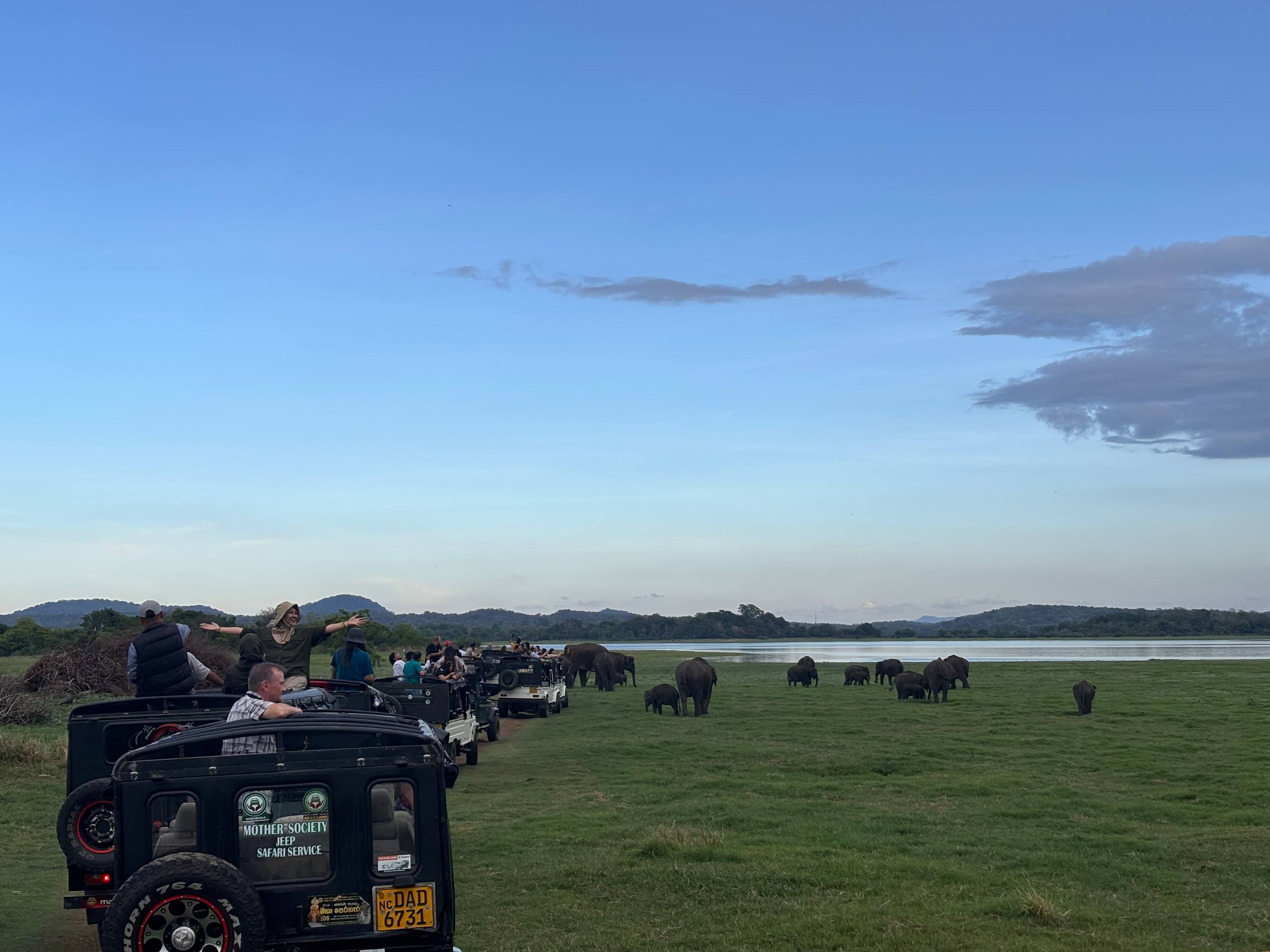
The road inside the park was a winding track of red earth, flanked by thick trees whose leaves were so dense they felt like green walls on both sides. Our jeep rolled along slowly, bouncing, and partway through a friend in a cream shirt suddenly stood up with a clenched fist in the air, like the winner of a race. Beside him sat a woman in a blue shirt and dark glasses, behind them a man in black, and on the other side a man in a white shirt held up his phone for a selfie, laughing broadly. From a distance, we looked like a happy family tour.
Whatever country we came from, on that jeep we were simply a bunch of grown-ups who had suddenly turned back into children. Nobody talked about work, nobody discussed contracts, and nobody checked email. The license plate of the jeep ahead of us, PP-7138, became a spontaneous running joke, and we playfully named ourselves “Team 7138” while photographing each other on that dusty track. From the jeep behind us came the laughter of other friends, while the jeep ahead disappeared around a bend, leaving a thin trail of dust drifting slowly through the evening light.
Grassland and Lake
Then the trees suddenly opened up, and the view in front of us silenced the whole jeep. A wide green meadow stretched all the way to the edge of a lake that shimmered silver in the distance, and above it the blue sky was streaked with white clouds and heavy gray ones drifting slowly. Beneath that enormous sky, elephants grazed calmly, as if the arrival of dozens of jeeps had nothing to do with them. It felt like stepping into a painting that had come alive.
A large mother walked closest to us, her gray skin wrinkled like an old map folded a thousand times. Near her feet, two younger calves busily pulled up grass with their trunks, and not far away a tiny baby clung to the side of another mother, who grazed while flapping her ears now and then. Far across the meadow, one more elephant stood alone near the water, small and calm in silhouette. The jeep engine was switched off, and all we could hear was the sound of grass being torn, the long breaths of the elephants, and the wind passing by.
The guide whispered that this is why Minneriya is so famous around the world. When the dry season comes, the water on one side shrinks and the herds move to the other side where water remains, like a natural network connected to itself, so at certain times hundreds of elephants can gather on the same lakeshore. He himself had once seen around three hundred in a single visit. We didn’t see that many that evening, but what lay before us was enough to make a friend from Korea cover her mouth with her hand and a friend from India raise his phone without a sound. Awe turns out to be a language everyone understands.
Home Full of Stories
Near six o’clock, the sun began to sink and the light turned golden, and the jeeps turned around one by one toward the gate. The ride back felt bumpier than we had imagined, and I finally understood why the guide had told us to nap earlier. Once we were back on the bus, the mood changed completely, because no one was sleepy anymore. Everybody talked at once, showing each other photos, laughing at their own faces on their phone screens, and comparing who had gotten the best angle.
Somehow the conversation jumped to snakes. Friends from India said that many people in their villages are bitten by snakes, and treatment is difficult if the victim doesn’t know which snake bit them, since antivenom is usually specific to a particular kind. The guide confirmed that it is the same in Sri Lanka, where sometimes the snake itself has to be brought to the hospital so that treatment is correct. A friend from Australia chimed in proudly that his country has the most venomous snakes, and the whole bus shivered and laughed. The guide named a few dangerous snakes in Sri Lanka, and we listened with a mixture of horror and delight.
When the conversation finally calmed down, someone asked about my country, and I answered eagerly about Indonesia, Bali, and Jakarta. Several friends said they had been there or had long wanted to visit, and the talk turned into swapping recommendations for restaurants, beaches, and festivals. That is how the evening went, with countries trading stories, tips, and promises to meet again at the next expo. Nobody was in a hurry to get off the bus when we finally arrived back at the resort.
What Remains
That night, in my room at the resort, I opened the day’s photos again, one by one. There was the photo of our jeep with five laughing faces on the open back, hands raised and phones held high, and there was the photo of the meadow, with the big mother elephant in front, her calves beside her, and the lake glittering in the distance. I remembered the list of names on my phone the day before, a column of numbers and unfamiliar names that had felt so cold. Now those names had faces, laughter, and stories that stayed in my memory.
The elephants didn’t care what countries we came from. They grazed, raised their young, and followed the water just as they have for thousands of years, and that evening 27 countries sat quietly in open jeeps, watching them with the same wonder. Perhaps that is the simplest lesson of Minneriya: sometimes what unites very different people is not a business deal or a formal handshake, but a shared silence in front of something far bigger than all of us.