
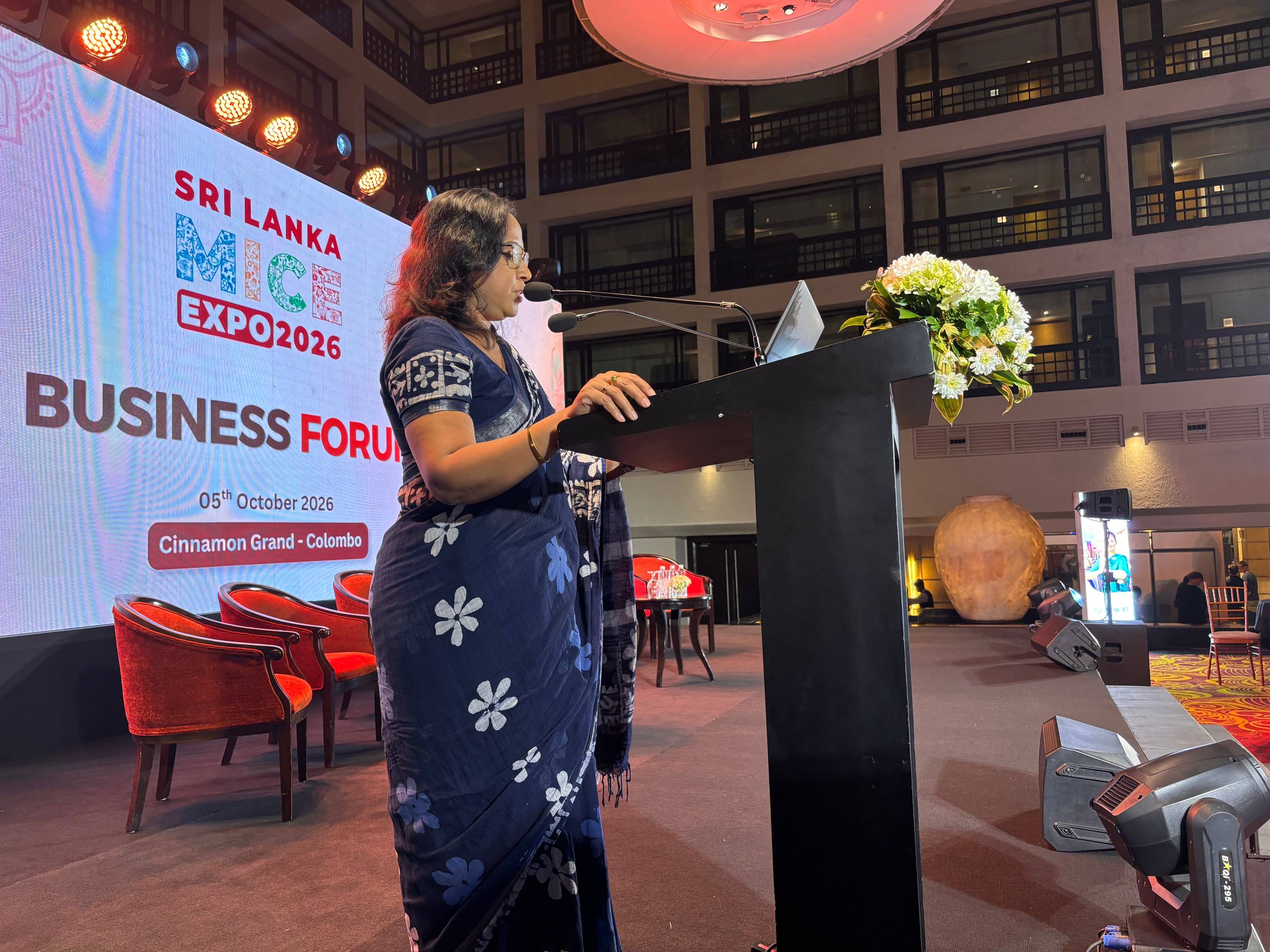
(Business Lounge – Marketing & Services) Tonight, I had the opportunity to attend the Business Forum & Welcome Dinner, an evening that brought together people with an interest in Sri Lanka’s tourism, business, hospitality, and convention industries. I came to the event not simply to attend a dinner, but to listen—to hear directly from people who are involved in developing Sri Lanka as a destination for international visitors, business meetings, conferences, and other major events.
One of the people I had the opportunity to meet during the evening was Malkanthi Welikala, Manager Marketing at the Sri Lanka Convention Bureau. She represents an organisation that has an important role in promoting Sri Lanka for the meetings and conventions market, a segment that connects tourism with the wider business economy.
Listening to the discussions tonight gave me a different perspective on Sri Lanka. Most international visitors probably know the country through its beaches, tea plantations, ancient cities, wildlife, food, and cultural heritage. Those attractions remain extremely important. But there is another side of Sri Lanka that deserves attention: its potential as a destination for business events and international gatherings.
The Business Forum & Welcome Dinner provided an opportunity to hear about that side of the country directly from people working within the industry. The conversations were not limited to tourism as a conventional holiday experience. They also touched on the importance of creating connections between businesses, destinations, hotels, event organisers, tourism professionals, and international visitors.
What I found particularly interesting was the relationship between business travel and tourism. Someone who comes to Sri Lanka for a conference or business event does not necessarily experience the country only through the meeting venue. There is the hotel, the restaurant, transportation, shopping, local attractions, cultural experiences, and potentially destinations outside the city. A business visitor can therefore become part of a much wider tourism ecosystem.
This is where the work of the Sri Lanka Convention Bureau becomes particularly relevant. Promoting a destination for international meetings requires more than simply having a suitable conference hall. International organisers also need confidence in accommodation, transportation, hospitality, professional services, connectivity, attractions, and the overall experience that can be offered to participants.
As I listened to the conversations during the evening, I could see how these different elements are connected. A successful international event can bring together hundreds or even thousands of participants, and each participant can generate activity across different parts of the local economy. The impact therefore goes beyond the event itself.
There is also something different about attending a business forum in person. Presentations can explain strategies and opportunities, but conversations between people provide another layer of understanding. A short discussion over dinner can reveal how people actually view the market, what opportunities they see, and what challenges still need to be addressed.Tonight was therefore not simply about listening to presentations. It was also about listening to people.
Meeting professionals such as Malkanthi Welikala helped put a human face on an industry that is often discussed only through statistics, hotel occupancy, visitor arrivals, conference numbers, or tourism revenues. Behind those numbers are people working to promote destinations, build partnerships, attract events, and create experiences for visitors.
I was also reminded that business tourism can be an important way for a country to diversify its tourism economy. Leisure tourism is naturally influenced by seasons, travel trends, consumer confidence, and international conditions. Business events have their own characteristics and can create demand for accommodation, venues, transportation, food and beverage, professional services, and other sectors.
Sri Lanka already has a powerful foundation for this. The country combines natural attractions with a distinctive culture, historical heritage, hospitality, and a strategic position in South Asia. The challenge is turning those advantages into a complete proposition that makes international organisers think of Sri Lanka not only as a place to visit, but also as a place to meet.That was one of the messages I took away from tonight’s gathering.
The address on the business card also tells part of the story. The Sri Lanka Convention Bureau is based at the Hotel School Building on Galle Road in Colombo 03, placing it within the country’s commercial and tourism environment. Its presence reflects the institutional effort behind attracting and supporting the meetings, incentives, conferences, and exhibitions market.For someone attending as a listener, there was another important lesson from the evening: tourism is increasingly about creating connections.
A destination can have beautiful scenery, but international business visitors also want accessibility, professionalism, reliable services, good hospitality, interesting experiences, and opportunities to connect with local communities and businesses. These elements together create the reason for people to come, stay longer, return, and recommend the destination to others.
The atmosphere of the welcome dinner made those connections even more natural. After the formal part of the forum, conversations became more personal. People introduced themselves, exchanged business cards, discussed their experiences, and explored possible connections. This informal part of the evening was perhaps just as valuable as the formal discussions.
For me, meeting Malkanthi Welikala and learning about the work of the Sri Lanka Convention Bureau added another dimension to my experience in Sri Lanka. It allowed me to look beyond the country as a tourist destination and understand some of the people and organisations working behind the scenes to develop its international profile.
Tonight’s Business Forum & Welcome Dinner was therefore an evening of listening, meeting, and learning. It brought together tourism and business perspectives in one room and showed how important human connections remain in building international relationships. I felt that experiencing a country does not always begin with visiting its most famous landmark. Sometimes, it begins with sitting at a table, meeting someone new, listening to their story, and understanding how they see the future of their country.