
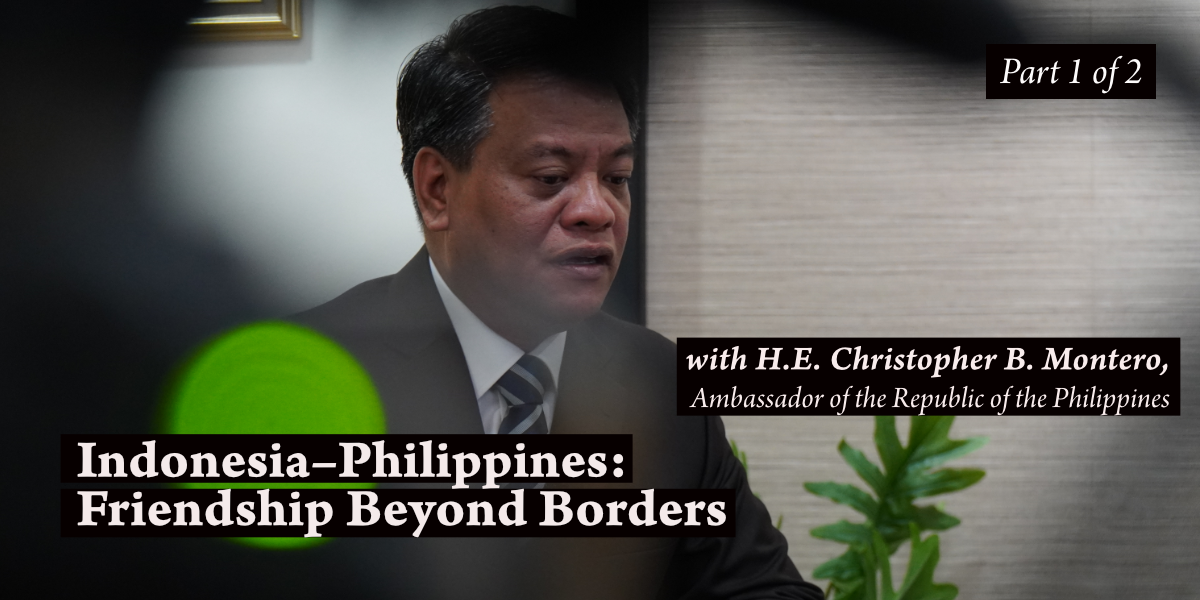
(Business Lounge Journal – Foreign Insight)
When we speak of Indonesia and the Philippines, we are not merely talking about two neighboring archipelagos separated by seas. We are talking about peoples whose histories, cultures, and destinies have long been intertwined—long before modern states drew maritime boundaries. As Ambassador Christopher B. Montero of the Philippines reminded us, “our ancestors were already freely moving across islands in our respective territories without any concept of national maritime borders.”
This spirit of kinship has carried forward into one of Southeast Asia’s most enduring partnerships. The Philippines was the first country with which Indonesia established diplomatic relations, and in 2024 the two nations celebrated 75 years of formal ties. Yet the roots of this relationship stretch much deeper, anchored in shared heritage and common aspirations.
The landmark 2014 agreement on the delimitation of exclusive economic zones across the Mindanao Sea, Celebes Sea, and Philippine Sea exemplifies how the two countries have transformed ancient connectivity into modern cooperation. Today, their partnership spans 93 bilateral agreements covering defense, maritime security, education, health, energy, and the creative economy. Trade between them reached USD 11 billion last year, with untapped potential in coconut-based products, processed foods, and fisheries—sectors that resonate with their shared geography and resources.
But beyond numbers, what makes this relationship unique is its human dimension. With nearly 400 million people between them, and 40 percent belonging to the youth sector, Indonesia and the Philippines are not just neighbors—they are co-authors of a regional future. Their collaboration in renewable energy, digital transformation, and creative industries reflects a shared determination to harness innovation while safeguarding food and energy security.
In a world often defined by borders, the Indonesia–Philippines friendship is a reminder that some ties transcend lines on a map. It is a relationship built on kinship, trust, and a vision of prosperity without boundaries. As both nations face the challenges of climate change, global volatility, and shifting economic landscapes, their partnership stands as a beacon of how neighbors can thrive together—not as rivals, but as family.